
Can LVP Be Used in Bathrooms and Kitchens?
Published June 15, 2021 · Updated on August 20, 2026 [VERIFY publish date]
Yes. Luxury vinyl plank is one of the best flooring choices for both rooms, provided you buy a product rated 100% waterproof rather than merely water-resistant, and provided the edges are finished tightly. It handles splashes, steam and mopping without swelling, it is warmer and softer underfoot than tile, and a damaged plank can be replaced without redoing the floor.
The two situations to avoid are a floor that needs a slope to a drain, and a room where the new floor will meet carpet or a different wood-look floor at the doorway.
Everything below explains that answer in more detail.
Whether you are starting a remodel or building from scratch, picking flooring for high-traffic areas is a tough decision. The kitchen and bathroom are where most spills happen, so you need a product with a completely waterproof rating. Unless you are seeking a real marble or tile look, luxury vinyl planks (LVP) offer those aesthetics and more with better comfort and a lower price point.
Waterproof or Water-Resistant? Check This First
These two phrases are used almost interchangeably in flooring marketing, and for a bathroom they mean very different things.
- Waterproof
- The plank’s core will not absorb water or swell, however long it is exposed. Most fully waterproof LVP uses an SPC or rigid core — a dense stone-polymer composite that does not react to moisture.
- Water-resistant
- The surface will shed a spill you wipe up promptly. Left standing, water reaches the core and the plank swells at the seams. This is fine for a kitchen with a careful household; it is a poor bet in a bathroom.
For bathrooms, buy waterproof and confirm it on the product specification rather than the marketing copy. If the description hedges, treat it as water-resistant.
The Other Three Specifications That Matter
- Wear layer
- Measured in mil, this is the clear protective coating on top of the plank. It determines how well the floor resists scratching and scuffing rather than water, and it is the specification that separates a floor that still looks good in ten years from one that does not. Thicker wear layers suit busy households, pets and kitchens.
- Slip resistance
- Bathrooms get wet, and a very smooth plank gets slippery. Many LVP ranges offer a lightly textured finish, which improves grip and generally looks more like real wood. Worth asking about specifically if there are children or older adults in the house.
- Thickness
- Measured in millimetres, thickness affects how solid the floor feels and how much sound it absorbs. It is worth noting that thickness on its own is not a durability measure — a thick plank with a thin wear layer will scratch sooner than a thinner plank with a heavy one. Waterproof core and wear layer come first; thickness is a comfort decision.
Advantages of LVP Bathroom Flooring
Standard sheet vinyl is often frustrating to install in bathrooms because cutting around toilets and sinks is time-consuming. LVP bathroom flooring is a superior alternative for several reasons:
- Easy Customization: Individual planks make cutting around counters and fixtures much more manageable than large sheets.
- Simple Repairs: If a section is damaged, you can pop out a single plank and fit a new one in rather than redoing the entire floor.
- Moisture Resistance: These planks maintain their quality even when exposed to splash zones and moisture from shower steam.
- Synthetic Durability: Made from synthetic materials, vinyl won’t absorb water like natural wood. While some laminates like Mohawk Revwood Plus or Shaw Repel Laminate offer high water resistance, LVP remains a top choice for complete moisture protection.
LVP in the Kitchen: What Changes
Kitchens are active workspaces that require flooring that is both durable and ergonomic. LVP kitchen flooring provides specific advantages for the heart of the home:
- Temperature Control: Vinyl stays at room temperature, ensuring you never have to worry about cold feet on tile or marble.
- Joint Comfort: Vinyl is softer and more flexible than tile, making it easier to stand on for long periods while cooking.
- Impact Protection: The flexibility of the material makes it less likely to break dropped items like mugs or glasses.
- Style Variety: While LVT is better for a ceramic look, LVP is the best way to achieve a mock hardwood aesthetic in a culinary space.
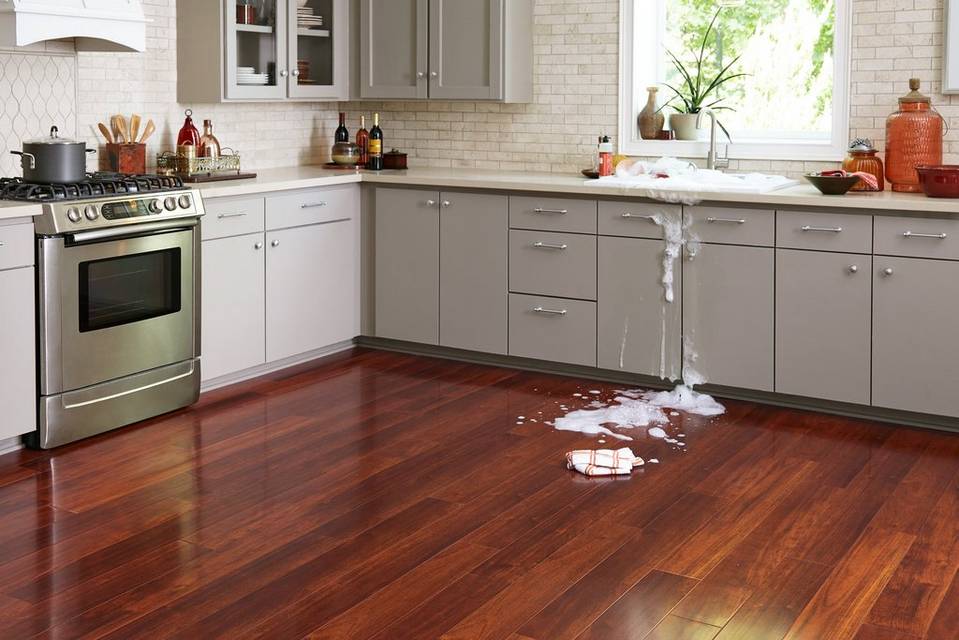
A kitchen puts different demands on a floor than a bathroom does. The water exposure is less frequent but more concentrated, and it usually arrives from an appliance rather than a person: a dishwasher seal that begins to weep, a supply line behind the fridge, a slow leak at the sink trap. These are the failures that damage a floating floor, because the water arrives underneath the planks rather than on top of them. Waterproof planks protect the floor itself; they do not protect the subfloor beneath it. Check under the sink and behind appliances periodically, and deal with a leak quickly.
Weight is the other kitchen consideration. A full refrigerator or a heavy range sits on a small footprint, and a floating floor needs to be able to move slightly with temperature. Appliances should not pin the planks in place, and heavy items are best slid on protective pads rather than dragged.
The advantage in a kitchen is real, though: LVP is warmer than tile on a winter morning, far more forgiving to stand on through a long cook, and quieter. It is also the only wood look that survives the environment — real hardwood in a kitchen is a maintenance commitment, and laminate swells if a spill sits.
LVP vs. Tile in a Bathroom
| LVP | Tile | |
|---|---|---|
| Waterproof | Yes, with a waterproof core | Yes, fully |
| Underfoot | Warmer, softer, quieter | Cold and hard |
| Installation | Floating, click-together, fast | Mortar and grout, slower, usually professional |
| Repair | Replace a single plank | Match and re-grout a tile |
| Maintenance | Sweep and damp mop | Grout needs sealing and cleaning |
| Sloped shower floor | Not suitable | The right choice |
| Cost | Lower material and labour | Higher |
Tile is the more traditional bathroom floor and the correct choice where the floor has to slope to a drain. For everything else, most homeowners now choose LVP for comfort, speed and cost — and because it can continue the same floor through the rest of the house, which tile cannot. If you want the look of stone in a bathroom without grout, a stone-look LVT is the closest thing. [VERIFY: the site has no ceramic/porcelain tile category — this link points to stone-look LVT instead]
LVP vs. Laminate in a Bathroom
Laminate has a fibreboard core. Even the water-resistant ranges will swell if water reaches that core and sits, and a bathroom eventually delivers water that sits. There are good laminate products with genuine moisture protection at the surface, and they are perfectly sensible in a hallway or bedroom, but a bathroom is where the difference between a fibreboard core and a stone-polymer core actually gets tested. For bathrooms we recommend LVP.
Tips for Installing LVP in Your Bathroom & Kitchen Floors
LVP Design and Layout Planning
Many homeowners maintain continuity in LVP placement for visual harmony across the whole home. Using the same LVP kitchen flooring as your living space creates a seamless transition that makes the home feel more expansive. When planning your layout, run the planks parallel to the longest wall to maximize this effect.
Managing Flooring Transitions
Issues of flooring transitions between LVP and carpet or hardwood can be solved with matching transition strips to bridge height differences. If continuity is not possible, it is often better to use a contrasting stone-look tile (LVT) rather than a wood-look plank that almost matches, which can ruin the visual flow.
Finishing the Edges
The perimeter is where a bathroom floor is most likely to fail. LVP is a floating floor, so it needs an expansion gap at the walls — but in a wet room that gap is also the route water takes to get beneath the planks. Cover it properly with baseboard or scotia, and run a bead of silicone where the floor meets the bath, the shower surround and the toilet flange. The aim is a gap that lets the floor move but does not let water through.
Aesthetic Warnings for Luxury Vinyl
Avoid using LVP as a quick update in aged bathrooms; if the fixtures and wall tiles are dated, the modern floor can create a visual mismatch that highlights the age of the room.
Choosing a Tone
In a small bathroom, lighter tones make the room feel larger, and a matt finish hides water spots and footprints better than a gloss. If the LVP is continuing from an adjoining room, match that floor rather than choosing for the bathroom in isolation — a floor that runs unbroken through the doorway is what makes the room read as finished.
Situations Where Luxury Vinyl Flooring is Not Recommended
While LVP fits the bill for easy maintenance and waterproof features, there are situations where luxury vinyl is not ideal for bathrooms.
- Subfloor Irregularities: LVP requires a flat surface. Significant sloping or divots in a bathroom floor can cause the locking mechanisms to fail.
- Standing Water Issues: While the planks are waterproof, they are not flood-proof. Persistent plumbing leaks can trap moisture beneath the planks, leading to subfloor damage.
- Complex Drainage: If you are building a walk-in shower that requires precise sloping toward a drain, traditional tile is the better choice.
Alternatives to LVP Flooring: Tile or Marble
If continuity is not possible or if your bathroom layout requires a rigid, grouted surface, using tile or marble is the recommended alternative. These materials provide a traditional solution for areas where a floating plank system may not be the ideal fit.
Shop Waterproof LVP for Bathrooms and Kitchens
Here at Georgia Carpet we carry many waterproof LVP collections, so you are sure to find a design that suits your decor needs. Request a quote today.
The results for this query contain no product listings at all — keep the product block after the answer, never before it.
FAQs About Installing LVP in Bathrooms & Kitchens
Do I need a moisture barrier under LVP in the bathroom?
A moisture barrier is typically recommended when installing over a concrete subfloor to prevent vapor from rising. However, if your LVP has a pre-attached underlayment, check the manufacturer instructions as an additional barrier may not be necessary.
What happens if vinyl plank flooring gets wet?
Waterproof LVP products are designed so surface spills and moisture will not cause the planks to swell, warp, or rot. As long as water does not seep into the joints and reach the subfloor, the material remains unaffected.
Should LVP go under the toilet?
Yes, LVP should be installed up to the flange, and the toilet should be placed on top of the planks for a professional look. This ensures a clean finish and prevents water from easily reaching the subfloor around the fixture.
Is LVP or tile better for a bathroom?
Tile is the better choice for a shower floor or anywhere the floor must slope to a drain. For the rest of a bathroom, LVP is warmer, quieter, softer underfoot, faster to install and less expensive, and a waterproof product handles the moisture just as well. Most homeowners now choose LVP unless they specifically want tile.
Does LVP in a bathroom hurt resale value?
Not when it is done well. A waterproof plank floor that runs continuously from the adjoining rooms reads as a finished, updated home. What does hurt is a floor that stops abruptly at the bathroom door against carpet or a mismatched wood look — the problem is the transition, not the material.
How long does LVP last in a bathroom?
A quality waterproof product with a heavy wear layer will last as long in a bathroom as anywhere else in the house, typically fifteen to twenty years or more in a residential setting. The variable is not the room, it is the wear layer and whether water is allowed to get underneath the planks.
Structured data added by these recommendations
Article       — headline, description, datePublished, dateModified, author,
                publisher, image, mainEntityOfPage, about[4]
BreadcrumbList— Home / Luxury Vinyl / Vinyl Information / this page
FAQPage       — 6 questions (3 existing, marked up for the first time; 3 new)
The live page carries only WebSite, WebPage and SearchAction markup. The three blocks above are live in this file’s <head> — view source to copy them. datePublished is a placeholder pending confirmation from the CMS; the live page shows only an “Updated on” stamp.